travelmemoirsofswaati text

I am an intrepid traveller. Travelling has been my passion since school days. Hailing from the steel city of Rourkela in Odisha, I always had an opportunity to plan out my holidays with my family to exotic destinations that are rich in history and heritage in India. Looking back, I have also taken up trekking in Chauragarh hills of Pachmarhi, Shatrunjaya Hills of Palitana, Vaishno Devi or the Muktinath temple in Mustang Valley in Nepal and Lalang Waterfall in rainforests of Tioman Island in Malaysia. I have penned down the Odisha destinations in Pick2Move-India Travel planner brought out by Sampan Media Limited, New Delhi. I have compiled a travelogue themed- “Journeys across India” published by Best Books, Kolkata. I generally take up travel to pen down travelogues, know the art and craft of the faraway lands and of course, I do travel reporting for leading English dailies of India.

ads by adsfor247

ads by adsfor247

Thursday, 5 February 2015

Heritage landmarks of Central India


Heritage landmarks of Central India
 
Awesome Gwalior Fort
 
Gwalior Fort
 
For those who are in love with heritage monuments and are planning a trip soon, why not visit Gwalior Fort, the most reachable destination in Central India. The historic city has witnessed the reign of great Indian dynasties ranging from Pratiharas to Kachwahas and Tomars to Scindias. The massive fort dominates the city skyline and it was our premier visiting destination in the city.
 
Rising at a height of 35 feet and being the most unconquerable fort in the country, the glorious fort stands witness to landmark historical events. We negotiated through a steep winding road at the entrance and sighted the Gujari Mahal that showcases impressive architecture from the medieval times. 
 
The 15th century monument was built in loving memory of the Gujjar queen, Mrignayani and there are rare antiques displayed at the Archaeological Museum in the monument.
 
Man Mandir Palace in Gwalior Fort
 
We proceeded uphill and came across Man Mandir Palace that was established by Raja Mansingh of Tomar dynasty. The palace is a fabulous example of Hindu architecture and its ambience echoes with the chivalry of Rajput rulers. The fort has other prominent attractions like Teli ka Mandir and Sas-Bahu ka Mandir. 
 
Teli ka Mandir- a 19th century monument soaring at a height of 100 ft presents an exotic blend of Dravidian and Indo-Aryan art. Tourists should not miss on Scindia School in the fort complex.
 
For those intending to take a peek into the royal lifestyle of Scindias, a visit to Jai Vilas Museum that forms the present residence of the royal Scindia clan is the right thing to do.
 
Maharaja Jiwaji Rao Scindia Museum
 
A portion of the place has been transformed into Maharaja Sir Jiwaji Rao Scindia Museum way back in 1964. Built in 1874, the palace is an Italian structure with the life-size statue of Sir Jiwaji Rao Scindia at the entrance. 
 
The icons of Scindia dynasty starting from the founder of the family-Maharaja Mahadji Scindia to the present member- Jyotiraditya Scindia are all framed in portraits. The museum has a host of galleries including coins gallery, carpet gallery, textile gallery, manuscript gallery, Nepal and Kashmir Art gallery, Malabar furniture, French furniture, Jacobean furniture gallery and Belgian cut glass gallery. Tourists should take a peek at Gwalior Sangeet Gharana that shows off an array of stringed instruments. The most astonishing item was a silver train chugging on miniature rails at the grand Durbar Hall.

Heroic flavours of Jhansi
 
Around 98 km from Gwalior is the fabled town of Jhansi in the heart of Bundelkhand region and the destination that is synonymous with the valiant deeds of Rani Lakshmi Bai that continues to reverberate in the hearts of millions. Jhansi has diverse attractions with forts, palaces and shrines and is rarely visited by tourists.
Amod Garden, Jhansi Fort
 
At Jhansi, we dropped in at Rani Mahal, the former residence of Lakshmi Bai. The 18th century palace was the brainchild of Raghunath II of Nawalkar dynasty that was converted into one of the residences of Lakshmi Bai. The palace has a flat roof with double storied structure on all three sides except the western side and there is a quadrangular courtyard. 
 
Rani Mahal has many rooms, six halls and parallel corridors with multi-fold arches that are done up in red colours flaunting floral and faunal designs. There are curios displayed on the ground floor comprising sculptural works collected from Barwasagar, Madanpur and Chandanpur of Jhansi and Lalitpur districts.
 
Our major attraction was Jhansi Fort snuggled on Bangra Hill, built by Bundela chief, Bir Singh Ju Deo dating back to 1613 AD. The famed fort sprawling over 16 acres of land has 10 gates and was once under the domain of Mughals, Marathas and British for a considerable period of time. It was under the stronghold of Rani Lakshmi Bai who had thrown the gauntlet against the Raj rule during Sepoy Mutiny in 1857. 
 
We checked into the major attractions of the fort like Kadak Bijli Canon and Panch Mahal- the three-tier storied building that formed the residence of Rani Lakshmi Bai and her husband, Raja Gangadhar Rao. There is Kal Kothri, the prison built by the Marathas and the well-known Jumping Spot that marked the escape point for the great queen from the hands of the British.
 
Bhopal- the heart of Malwa
 
Bhopal was founded by the legendary Paramar ruler of Dhar, Raja Bhojadeva sometime back in 11th century A D while the princely state and the present day city of Bhopal has been the discovery of Afghan ruler- Dost Mohammad way back in 1723. During the rise of British rule in India, Bhopal was the second largest Muslim state and remained a separate state till in 1949 when it joined with Independent India.
 
On our premier visit to the city back in 2000, we travelled to Bhojpur that lies around 28 km from the city. The quaint little hamlet of Bhojpur is well-known for 12th century Bhojeshwar temple that honours Lord Shiva. 
 
The shrine is a protected monument and is popular as “Somnath of the East.” It attracts devotees in droves and is set on a raised stone ramp with its ornate dome supported by four huge pillars with tapering ends representing an amazing structure. 
 
The giant lingam in the sanctum rests on a huge square-shaped platform measuring 21.5 feet and is composed of three limestone blocks. It is the rare architectural gem that makes the lingam light and solid. The interiors of the shrine comprise a large ornate ceiling with concentric rings that have impressive mythical figures engraved.
 
From Bhojpur, we returned to the walled city that wears a traditional look with the bustling Chowk and vibrant markets.
 
Taj-ul-Masjid
 
We had a glimpse of Taj-ul-Masjid, the largest mosque in India that was established by Shah Jehan Begum, the queen of Bhopal. The towering mosque is characterized by inter-arched roof, broad façade and a large courtyard that makes it stand apart from other Indian mosques. Some of the other popular monuments belonging to medieval period are Jama Masjid with gold spikes adorning the minarets, Moti Masjid, and Sadar Manzil.

World-famous Stupas of Sanchi
 
Quite close to Bhopal is the Buddhist landmark of Sanchi that is nearly 10 km from Vidisha in Raisen district on the Itarsi-Jhansi section of Central Railways. Sanchi is a picturesque, tranquil getaway that has many global tourists. It was the Mauryan Emperor, Ashoka, the great Buddhist patron who laid the foundation of a Buddhist bastion on Sanchi hill or Vedisagiri in search of peace and tranquillity with a view to lead an austere life.
 
Listed as UNESCO’s World Heritage Site, Sanchi is renowned the world over for its magnificent stupas, monasteries, temples and uniquely carved pillars that are open from sunrise to sunset. The centuries-old stupas came up between 3rd century BC to 12th century AD and stand witness to glorious Buddhist era.
 
Sanchi Stupa No 1
 
We first headed to Stupa No.1; a brilliant piece of architecture set up by Emperor Ashoka as early as 2nd century BC and has been carved from Chunar sandstone. Being the oldest stone structure in India, the stupa has a huge plastered dome in the form of a hemisphere crowned by a triple umbrella. There are the renowned Four Gateways- Eastern, Western, Northern and Southern gateway that provide unforgettable glimpses of Buddha’s journey of life towards enlightenment in the form of exquisite carvings.
 
The best thing about going to the Great Stupa 1 at Sanchi is that one can get to view the Four Gateways. We gazed at the lofty gateways that portray the Jataka Tales that have been finely chiselled with rich motifs and serve as best examples of early classical art.
 
Near the Southern Gateway is Stupa No3 that is decorated by an umbrella. We also sighted the 5th century Gupta Temple lying in ruins that represent one of the earliest examples of Indian temple art. The lion capital of the Ashokan Pillar is preserved in the museum run by Archaeological Survey of India (ASI).

Tuesday, 3 February 2015

Saurashtra- World of pilgrims

Saurashtra-World of pilgrims

Dwarka- where pilgrims congregate

The pilgrim land of Dwarka reminds me of the times when I had packed my bags and set out for a pilgrim tour along with my family sometime in 2004. The land steeped in myth and history on the Kathiawar Peninsula, Dwarka on the southern coast of Gujarat is one of the revered pilgrim centres in India. 
 
A 450-km-long drive from Ahmedabad on the National Highway No.8A brought us to the renowned temple resort of Dwarka where the mesmerizing chime of bells rent the ambience and soothes the tired minds with the promise of harmony and rejuvenation.
 
Dwarkadhish Temple on the banks of Gomati
 
The magnificent shrine of Dwarkadhish on the banks of Gomati creek draws a large chunk of pilgrims. Known as Jagatmandir, the five-storied shrine spreading over 4,000 sq. ft houses the black idol of Lord Krishna that is said to be over 2,500 years old and was the creation of Badrinath, the great grandson of Lord Krishna.

At Dwarka, we were at Toran Tourist Bungalow of Gujarat Tourism. We had an opportunity to watch the Mangla aarti in the wee hours of dawn at Dwarkadhish temple. There are 60 granite and sandstone pillars that are intricately carved in the shrine with a shikara rising to 170 feet. Other significant shrines in the complex are Satyabhama, Saraswati, Pradyumna and sage Durwasa. Here Prasad is locally known as Loni that conjures sweet butter.

Travelling another 16 km from Dwarka, we came across Nageshwar Mahadev that has the smallest jyotirlingam in India. From here, we were on to Beyt Dwarka, around 30 km away from Dwarka. A saying goes on that no visit to Dwarka is complete without a pilgrimage to the ancient holy site of Beyt Dwarka. 
 
We landed at Okha Port that offers sound views of saline marshes formed by Arabian Sea at Okha Rann where thousands of migratory birds flock. We hired a steam launch at Okha Port and departed for a 45 minute- cruise to Beyt Dwarka. 
 
The temple town of Beyt Dwarka belongs to hoary past and has the shrine of Beyt Dwarkadhish with hand-painted interiors, adorned doors, windows, balconies and pillars. Mythology puts forth that this was the place where Lord Krishna resided along with his family. We also visited temples of Jambuwanti, Satyabhama and Devaki. 
 
Rukmani Temple
 
 
While returning from Beyt Dwarka, we stopped at Rukmani temple, only 12 km from Dwarka. The splendid limestone shrine dates back to 1,600 years old.


Religious relevance of Veraval

From Dwarka, we travelled to Veraval, the bygone port and close to it is the holy Bhaluka Teerth where Lord Krishna breathed his last before being shot by a hunter. The shrine honours Lord Krishna apart from the legendary Peepal tree where the Lord had departed. Pilgrims can watch the Triveni Sangam- the confluence of three rivers including Hiranya, Kapila and Saraswati. 
 
Nageshwar Mahadev Shrine, Dwarka
 
It is widely believed that the last rites of Lord Krishna were performed on the Hiranya river banks on the spot known as “Dehotsarg” and the complex is famed as Prabhas Kshetra with Geeta Mandir and Naagshtan that marks the transformation of Lord Balaram into a snake before entering into the ground.


Somnath- the land of divine faith

Somnath Mahadev Shrine
 
Veraval is the gateway to Somnath in Junagadh district and the renowned Somnath Mahadev shrine lies on the tip of Saurashtra Peninsula that has tempted pilgrims, history buffs, archaeologists and travellers ever since inception. Spread over 5 sq. km on the shores of Arabian Sea, the legendary 12th century shrine of Somnath has the premier jyotirlingam of India that was ravaged 11 times by Mohammad of Ghazni. 
 
Renovated by Sardar Vallabhai Patel around five decades ago, the shrine has a unique location since there is no land between the shrine and the South Pole. We were amazed by the ornate silver doors, umbrellas and chandeliers in the sanctum. There are highly decorated stone columns with mythical figures in the shrine that provide the best example of Chalukyan art.


Palitana

On our last leg of Saurashtra tour, we were at Palitana in Bhavnagar district where we halted at Hotel Sumeru owned by Gujarat Tourism. We were excited to begin our trek to the sacred mountains of Palitana and reached before dawn at the foothills. 
 
We began our arduous trek of 4 km to the Shetrunjaya Hills at a height of 1,800 feet comprising 3,745 steps. Once we began our climb, it was an amazing experience. We experienced the break of the dawn with the cool air soothing our body and river Shetrunjaya gleamed like a silver coil far away. It took two-and-half hours to complete the trek when we finally reached the gallery of shrines.

We spotted as many as 863 exquisitely carved shrines that form the largest Jain temple complex in North India. The sacred shrines of Palitana belong to 13th century and were crafted by the craftsmen who were involved in the creation of fabulous shrines of Dilwara and Ranakpur.
 
Shri Adishwara Temple
 
The most significant shrine is Shri Adishwara temple honouring Rishabhdev, the first Jain Tirthankar and was set up at a cost of Rs 2.97 crore. The Sausthambh temple has 100 pillars and Shantinath temple is dedicated to Bahubali and Bharat, the brother Lord Rama. 
 
There are ashtadhatu images of Pandavas, not to mention the Hindu shrines of Hanuman, Saraswati and Lord Shiva. Once our trek was over, we began our return trek. We were tired and were beaten by hunger pangs when we indulged in having masala dahi sold by Rabadi women. Once the trek was over, I was filled with a sense of contentment.


Ambaji

Temple of Amba Mata at Ambaji
 
For pilgrim travellers on a spiritual tour of Saurashtra, Ambaji is a 200 km drive from Ahmedabad in the Banaskantha district of Gujarat that provides views of scenic landscapes of Arasur Hills in the Aravalli range. One of the most popular pilgrim destinations in Saurashtra, the revered Shakti Peeth of Ambaji is crafted in marble and is fondly known as “Mota” (elder) Ambaji among devotees. The shrine adores Goddess Ambaji without any idol. One would come across a triangular yantra in the sanctum sanctorum. Devotees throng here during Navratri and full moon fairs are held in Chaitra, Kartik and Bhadrapad.


Monday, 2 February 2015

Alluring Western Chats


Alluring Western Ghats

Mahabaleshwar-The land of strawberry
 
The most exciting destination on the Western Ghats in Satara district of Maharashtra is Mahabaleshwar that was the bygone summer capital of Bombay Presidency. The charm of the hill resort of Mahabaleshwar is incredible offering unending vistas of natural beauty, virgin peaks, verdant groves of valleys, meandering roads, plateaus and the best glimpses of Western Ghats. The hill resort has everything. There are pilgrim points, waterfalls, lakes and strawberry gardens and we couldn’t have bargained for more. There are a plethora of activities for tourists and they can indulge in bush walking, horse riding, boating on Venna Lake and strawberry gardens.
 
Around 120 km from Pune and a 3½ hour-drive by Volvo brought us to the ancient hill resort of Mahabaleshwar. For pilgrims, the hill resort has 450-year-old Panchganga temple that constitutes the source of five rivers- Savitri, Krishna, Saraswati, Gayatri and Koyna. Lying about 9 km from the town, the shrine honours Lord Krishna and Brahma and waters of five rivers gush out from the mouth of the Nandi forming a spring. 
 
There are many fascinating points around the hill resort like Arthur’s Seat with mesmerizing views of the Western Ghats. One can go to Hunter Point and Echo Point that echoes with the buzzing sound of scores of honey bees. A visit to Tiger Spring has water gushing out from a needle-like hole and Window Point has breathtaking views of Western Ghats. One can drive 6.8 km from the town to reach Kate’s Point to enjoy unforgettable glimpses of Krishna Valley and Deccan Plateau. 
 
Needle Point, Mahabaleshwar
 
The attraction of Needle Point is quite tempting that has a portion of the hill resembling an elephant’s face.
Lodwick Point
Perched at a height of 1,240 metres from the ground is Lodwick Point at a distance of 4.8 km away from the town and a favourite destination for travellers. The first Britisher, General Peter Lodwick had set foot in Mahabaleshwar after trekking through rough terrains in 1824. A monument in memory of General Lodwick has been erected.

A pilgrim’s passage to Bhimashankar
Bhimashankar Shrine
 
Nestling in the Western Ghats and nearly 130 km from Pune is the pilgrim resort of Bhimashankar in Pune district that has one of the 12 jyotirlingams of India where pilgrims in droves congregate.
 
A three-and-half hour drive from Pune through jungle clad and semi-barren hills of Western Ghats offered wondrous glimpses of nature. Lying on the banks of river Bhima, the pilgrim point of Bhimashankar rests in Bhimashankar Wildlife Sanctuary in the midst of thick floral groves. The highly revered shrine has been the creation of Nana Phadnavis, the famed statesman. The huge black shrine with interior carvings houses the idols of Shiva and Parvati and Lord Ganesha.

Sunday, 1 February 2015

Gandhi trail in Saurashtra

Gandhi trail in Saurashtra
 
Dollops of history in Ahmedabad 
 
Way back in the last decade, a journey to Ahmedabad provided us an opportunity to have glimpses of Sabarmati Ashram- a dream conceptualized by Mahatma Gandhi. The sylvan environs on the banks of river Sabarmati represent an ode to simplicity and idealism. It was here way back on March 12, 1930 that the historic Dandi March took off for the coastal hamlet of Dandi.
 
A view of Gandhi Ashram
 
At Sabarmati Ashram, we stepped into Hriday Kunj- a simple ashram where Gandhiji stayed from 1918 to 1930 and the regular items like the spinning wheel used by Gandhiji are preserved here. A visit to Vinoba Kutir that formed the residence of Vinoba Bhave from 1918 to 1921 is worth the experience.
 
Ahmedabad prides in some of the impressive shrines like Shri Radha Govind Dham, an enchanting shrine done up with intricately carved doors with aluminium engravings and painted interiors that portray the life of Lord Krishna. There is Vaishno Devi Teerth Dham – a cave shrine replica of Vaishno Devi shrine in Jammu. For history buffs, a visit to Adalaj Vav or steep well is a must lying about 17 km north of Ahmedabad. A unique five-storied well set up in 1499 has four highly carved pavilions.
 
The old quarters of the city has Siddi Saiyed Mosque that displays sandstone latticed work. The mosque was the work of Siddi Saiyed, a slave of Ahmed Shah, founder of the city of Ahmedabad. At the Sidhi Basher mosque, there are architectural wonders of the famed Shaking Minarets or Jhoolta Minar where when one minaret is moved with force, the other shakes in sympathy.
 
No tour of Ahmedabad is complete without a visit to the holy citadel in pink sandstone called Akshardham in Gandhinagar. Sprawling over 23 acres of land, the glorious shrine of 108 feet has a gold-plated copper statue of Lord Swaminarayan and the shrine is supported with 97 carved pillars, 17 domes and 8 ornate windows. It is a brilliant mix of ancient and modern artistry.

Gandhiji’s ties with Rajkot
 
Our next destination was Rajkot, around 216 km from Ahmedabad where Mahatma Gandhi had his early education. Once the capital of Saurashtra, Rajkot is one of the largest cities in Gujarat that has Mohandas Karamchand Gandhi Vidyalay or Alfred High School set up in 1874. Rajkot has Ramakrishna temple bearing an elaborate display on the life and teachings of Ramakrishna and Sarada Devi and the global spiritual mission of Swami Vivekananda.

The charm of Porbandar
 
While trailing in the land of Mahatma, our ultimate destination was Porbandar or the “Yellow City” on the sea shore that evokes strong memories of Gandhiji. Porbandar was earlier known as Sudamapuri since it is the birthplace of Sudama, Lord Krishna’s friend. 
 
Bharat Ashram at Porbandar
 
 We headed to Kirti Mandir, the three-storied ancestral residence of Gandhiji. He was the fourth son of Putlibai and Karamchand Gandhi who was born in 1869 AD and the place of his birth is marked with a mystic cross. The residence has a library, prayer hall and oil paintings. One should not miss out on Bharat Mandir on Dayanand Bagh that was set up in 1956. The sprawling temple has a relief map of India and its walls have life-size works on canvas of Indian luminaries. 

Saturday, 31 January 2015

On the trail of Narmada

On the trail of Narmada
 
Amarkantak: Queen of Maikal beckons
 
Amarkantak in the Shahdol district of Madhya Pradesh is renowned as the “Queen of Maikal Hills” and forms the source of the mighty Narmada.
 
Narmada Mata Mandir, Amarkantak
 
For travel buffs in search of a blend of pristine natural world and spiritual ambience that is far behind the contemporary world, a visit to Amartkantak would be their ideal choice. Amarkantak boasts of the confluence of three rivers of Central India- Narmada, Johila and Sone.
 
It was on one of those Navratri days during late ‘90s when we made our way by jeep from Pendra Road, lying 42 km from Amarkantak and it was a bone-jarring journey. Amarkantak range lies at 1,000 metres height and we passed through the vast forest lands of Bhundokona, Jaleshwar and Amanala.
 
It was at Amarkantak that I had an experience of staying at a dharamshala and the town experiences frequent blackouts. The next day, we set out for Kapil Dhara, nearly 6 km from the source of Narmada river. It is one of the highest waterfalls fed by river Narmada and marks the union of three mighty ranges- Satpura, Vindhya and Maikal. 
 
At Kapil Dhara, the torrential waters of Narmada gush down the rocky slopes from a height of 3,200 metres forming echoes. Going downhill, we came across a serene white cascade called Doodh Dhara.
 
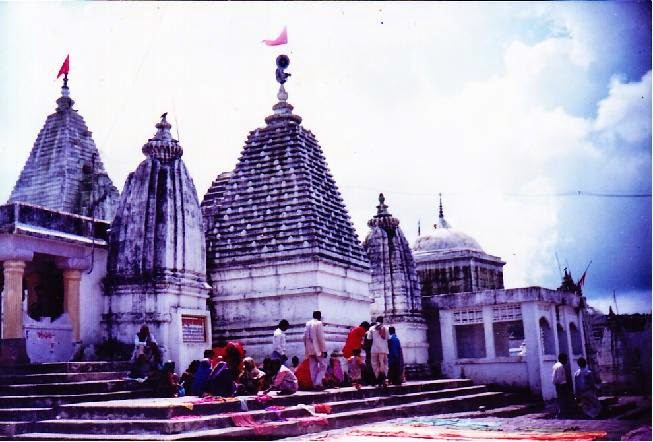
We wended our way to the imposing Narmada temple dedicated to Goddess Narmada and it is here that the river originates in the Narmada Kund. The shrine reflects an age-old charm and is thronged by a flurry of devotees. We wandered off to Mai ki Bagiya, at a distance of four-and-half km from the shrine complex that marks the confluence of rivers Son and Bhadra.
 
The Gond land of Jabalpur
 
The largest city on the banks of Narmada and the third most highly populated city in Madhya Pradesh is Jabalpur, once the seat of Gond rulers that echoed with the chivalry of the Gond queen, Rani Durgawati. If one wants to commune with nature, then the best destination is Marble Rocks at Bhedaghat on river Narmada at a distance of 16 km from the city.
 
At Bhedaghat, nature is at its best and there’s no better way to explore the sight than visiting on the occasion of Narmada Mahotsav during Navratri. 
 
Marble Rocks
The entrance of Marble Rocks has the statue of Lord Hanuman and as you turn around, there is the swift-flowing river Narmada meandering along the Marble Rocks that plunge into a smoke cascade called Dhuandhar providing vintage beauty of nature. Visiting Bhedaghat during moonlight is a different experience for travellers.
 
We proceeded from Dhuandhar to the famed 19th century Chausat Yogini shrine devoted to Goddess Durga.
 
Madan Mahal Fort
 
The city also has Madan Mahal Fort, a creation of Gond ruler, Raja Madan Shah that serves as the best example of medieval construction. The fort has been carved on a huge rock and served as a watchtower during the reign of Rani Durgawati. There is Shiv Pancheshwar temple and Sharda Mata temple in the vicinity. We negotiated a number of steps to get a glimpse of Shiv Pancheshwar temple with the Lingam installed in the rock cave.
 
Omkareshwar- A pilgrims’ world
 
When I travel from Indore to Khandwa, I can never miss out the Om-shaped Island resting on the Malwa Plateau formed at the confluence of two rivers - Narmada and Kaveri. It’s none other than the divine pilgrim town of Omkareshwar that has one of the 12 jyotirlingams. The holy town injects a breath of fresh air into humdrum living and rejuvenates the minds of pilgrims. 
 
Omkareshwar
 
The journey from Khandwa to Omkareshwar is really enchanting with scores of soyabean fields and cotton cultivation spreading across the blue hills along the horizon. We were at Yatri Niwas in the holy town of Omkareshwar that is best visited during Navratri when the sleepy pilgrim town wakes up to a vibrant festive mood. We made our way to the shrine of Omkar Mandhata snuggled on the foot of Mandhata Hill and lies on a tiny island formed by the fork of Narmada. 
 
The shrine is across the Narmada Bridge that provides fascinating view of the river. Mythology puts forth that King Mandhata, the ancestor of Lord Rama had meditated on this spot and moved by his devotion, Lord Shiva had granted him the throne here in the form of Om-shaped Island. 
 
The throne of King Mandhata is still preserved in the shrine. It was at this site that Shankracharya, the great Hindu reformer derived his divine powers from his mentor- Govindacharya. The shrine has a frieze of figures carved from soft stone. 
 
Other temples to look for are Shri Batuk Bhairav temple, Pataleshwar, Narmada and Navgraha temples. Before departing, we trekked our way to Siddhanath temple resting atop Mandhata Hill and built in early medieval Brahminic style.
 
Medieval world of Maheshwar
 
Maheshwar on the banks of Narmada in Khargon district of Madhya Pradesh was the brainchild of Rani Ahilyabai Holkar of Indore. Around 91 km from Indore, Maheshwar formed the seat of Malwa culture and was best known as Mahismati during the epic period. The road to Maheshwar from Indore is a convenient journey than the one from Mandu.
 
Maheshwar Fort is the calling card of the town that dominates the town and has the palace or Rajwada replete with an array of shrines and ghats on the banks of river Narmada. Sprawling over 2 km, the Rajwada is a colossal fort with towering gateways- Ahilya Dwar and Kamani Darwaza. 
 
Once inside the fort, we took time to visit Rajrajeshwar temple, a prominent religious shrine with profusely carved doorways. The shrine honouring Lord Shiva has 11 Nanda Deepak burning all round the year symbolizing happiness.
 
Vithaleshwar Temple
 
At Maheshwar, I had put up at Yatri Niwas overlooking the fort. There are other popular shrines in the fort complex- Ahileshwar and Vithaleshwar temple with adorned overhanging balconies. Each shrine has a flight of steps leading to the picturesque ghats like Ahilya Ghat, Peshwa Ghat, Vishwanath Ghat and Fanse Ghat.
 
Bewitching Mandu
 
The medieval town of Mandu on Malwa Plateau in Dhar district at an altitude of 2,000 ft in western Madhya Pradesh brings back memories of royal grandeur that stand in ruins. The town overlooks river Narmada that flows thousand feet below. 
 
It was in Mandu, well-known as ‘the City of Joy” that we could sight the architectural grandeurs of Islamic Pathan art and the town once witnessed the blooming romance of Rani Roopmati and the poet prince, Baz Bahadur.
 
I recall back a decade ago, when I was on a tour of Ujjain, I landed up in Mandu en route Dhar and stayed at Tourist Rest House that overlooks Jami Masjid in the hub of the town. Mandu is enclosed by 12 gateways of which Delhi Darwaza stands apart. 
 
The architectural landmarks are all in Central Group and the Royal Enclave or Shahi Parisar. Some of the spectacular monuments that I came across in Central Group are Hoshang Shah’s Tomb, the first marble edifice of India and the one of the best examples of Afghan art that later inspired the builders of Taj Mahal. 
 
There is the splendid Jami Masjid modelled on the Great Mosque of Damascus. 
Ashrafi Mahal
The Ashrafi Mahal or “The Palace of Gold Coins”, built by the Malwa ruler, Mahmud Shah Khilji overlooks Jami Masjid.
 
A walk down the Royal Enclave brought us to Jahaz Mahal or “Ship Palace” tucked between two lakes, Munj Talao and Kapur Talao. We did not miss on the attractive Hindola Mahal or “Swinging Palace” with sloping walls and ornamental façade in sandstone. 
 
The enchanting Nahar Jharoka or “Tiger Balcony”, built by Emperor Jehangir and Dilwar Khan’s Mosque with Islamic Pathan architecture are other prominent attractions in Royal Enclave. 
 
Roopmati's Pavilion
The special attraction of Mandu is Roopmati Pavilion that offers a sweeping view of 16th century Baz Bahadur Palace. Before winding up, we visited the Sunset Point for a panoramic view of Malwa Plateau. Apart from the bygone royal glory, one can get to interact with the tribal settlements like Bhils, Garasias and Kalals in Mandu.