Desert Kaleidoscope
 |
| Swaati |
I have
traversed all the three desert cities of India - Jodhpur, Jaisalmer
and Bikaner that make the Desert Triangle and the entire desert land
is replete with endless forts and palaces that bask in regal
splendour.
My
desert sojourn began with Jodhpur – the second largest city in
Rajasthan way back in October, 2012. We packed our bags in advance to
head to the legendary city of Jodhpur, the bygone capital of Marwar
that was discovered by Rao Jodha in 1450 A.D, the chief of Rathore
tribe of Rajputs who claimed to be the descendent of Lord Rama.
UMAID BHAWAN PALACE
 |
| A view of the famous Umaid Bhawan Palace |
Best
described as a miracle in sandstone, Umaid Bhawan Palace is one of
the largest global palaces and the last of India’s palaces that has
been the manifestation of Maharaja Umaid Singh (1903 to 1947) of
Jodhpur.
The palace is done up in Deco style and brings to life the
grand lifestyle of Rajput rulers of Marwar. The work was done by a
Polish artist- an amateur interior designer. The palace is the
residence of Maharaja Gaj Singh II of Marwar and a portion of it is
transformed into a heritage hotel and museum.
Once
well-known as Chittar Palace, Umaid Bhawan prides in having a robust
foundation built by the highly skilled workers of Agra and Fatehpur
Sikri in 1929. Like all Rajput palaces, Umaid Bhawan is categorized
into Zenana Mahal and Mardana Mahal replete with Durbar and banquet
halls.
 |
| Inside view of the Palace |
There is a separate section that houses an astounding
collection of Venetian, Bohemian and English glass wares dating back
to 20th century collected by Jodhpur Maharajas during
their visit to England. Viewing the palace was a marvellous
experience for us and we were filled with memories to last a
lifetime.
MANDORE
No trip
to Jodhpur is complete without a visit to the ancient town of Mandore
that lies 15 km away. An hour drive from Jodhpur brought us to
Mandore and it was here that we could get glimpses of 6th
century Marwar.
 |
| A ruined fort |
The legendary town of Mandore was once famed as
Mandavyapur that formed the regal capital of Gurjara Pratihara
dynasty of Marwar kingdom from 6th to 12th
century A.D. A flourishing town in medieval India, Mandore finds it
mention in Ramayana as the home town of Mandodari, the wife of
Ravana. Life stands still in this fabled town of Marwar where the
clock hasn’t clicked for centuries.
We
visited the fascinating garden and the attractive cenotaphs or
chhatris that trace back to bygone rulers of Marwar.
 |
| Ajit Gate |
The
cenotaphs served as the crematorium of the royal dynasty of Jodhpur.
 |
| Bhairoji temple |
We made our way through the towering Ajit Gate done up with toran
gateway to visit the highly revered Bhairoji shrine locally
called Kala Bhairo.
EKTHAMBA MAHAL
 |
| Ekthamba Mahal |
The
three-towered structure is a rich architectural grandeur of Marwar
built during the times of Maharja Ajit Singh. The ruined ancient fort
of Mandore belongs to post Gupta period where we came across carved
inscriptions suggesting that the fort was frequently invaded by
Mughal Emperors like Iltutmish, Feroze Shah Tughlaq and Jalal-ud-din
Khilji.
JAISALMER
Rising
like a phoenix in the sky is Jaisalmer – best known as the “Golden
City of India” that was popularized by the late film maestro,
Satyajit Ray in his popular hit- Sonar Kela. Since a
train journey from Jodhpur to Jaisalmer is an exciting one, we
boarded the train to get fascinating views of desert countryside.At
a distance, the Golden Fort or Sonar Kila appeared like the
sentinel in the sky.
Jaisalmer has its own charm for history buffs since they get to
explore forts, resplendent palaces, heritage mansions and gateways.
It was in 1156 AD that the city was discovered by Rawal Jaisal, a
Bhati Rajput who belonged to the Yadava clan. Rising 80 metres from
the ground on the Trikutha Hill is the Golden Fort built by Maharawal
Jaisal Dev that forms the pride of Jaisalmer. The fort has four
gateways- Akhey Pol, Ganesh Pol, Suraj Pol and Hawa Pol.
MAHARAJA MAHAL
The
chief attraction of the fort is the 850-year-old Fort Palace Museum
and Heritage Centre famed as the Maharaja Mahal. We climbed
the five-storied colossal structure to gape at the amazing
architectural wonders. The first floor has the Armoury House
displaying the weapons used by Nepali Gurkhas, the second
floor portrays the coronation of the present Maharaja of
Jaisalmer-Maharawal Brij Raj Singh, the third floor has Akhey Vilas
preserving fish and Kalasia symbols of the royal family and
the fourth floor is Sarvottam Vilas with latticed windows. I came
across the family tree of Lord Krishna in the Maharaja Mahal
providing complete info on the Yadava clan that is by far, the most
interesting aspect for tourists.
BADAL VILAS
Another
impressive heritage site is the residence of the present Maharaja of
Jaisalmer with beautiful taazia on the rooftop.
NATHMAL'S HAVELI
The
19th century monument exhibits a brilliant piece of
craftsmanship done up with floral patterns on lattices, artistic
pillars, balconies, projections and doorways. Set up by Maharawal
Bairisal, the former ruler of the city, it was gifted to his Diwan,
Nathmal.
PATWA HAVELI:
This
19th century haveli is a sight to behold where a
traveller gets carried away by the artistic brilliance of the
interiors of the mansion. Built by a wealthy merchant, Gumanmal
Bafna, the haveli has massive carved doors embellished in
ivory works. The inner roof flaunts golden paintings and the walls
are of Belgian glasses with lattices.
GADISAR LAKE
 |
| Gadisar Lake |
It is
an ideal place to chill out in the desert city with a man -made lake.
For those interested in gateway architecture in India can take a look
at the massive, arched gate built in yellow sandstone and adorned
with lattices and balconies.
LUDERWA
We took
a 15 km desert drive from Jaisalmer to reach the age-old town of
Luderwa, the former capital of Jaisalmer. Once known as Lodhervapur,
the Shwetambhar Jain temple renovated in 1635 has the black idol of
Lord Parasnath. The most interesting feature of the temple is the
footprints of all 24 Jain Tirthankaras right from Rishabhnath to
Mahaveer. We could sight the 400-year-old Kalpavriksh in the shrine
complex.
BIKANER
The
desert city of India was founded by the Rathore Prince-Rao Bikaji,
the son of Rao Jodhaji, the founder of Jodhpur in 1488 AD.
BHANDASAR JAIN TEMPLE:
 |
| Bhandasar Jain Temple |
 |
| Interiors of Bhandasar Jain Temple |
 |
| Painted ceiling |
The
oldest of the Jain shrine in the walled city dates back to 1468 AD
before Bikaner was founded.
Set up by Bhandasa Oswal, the shrine
honours Sumathinathji, the 5th Jain Tirthankara and has
richly coloured painted ceilings, walls and pillars depicting the
tales from Jain scriptures.
BIKANER FORT
 |
| Bikaner Fort |
The
seminal attraction of Bikaner is the fort popularly called Junagarh-
rated as the finest land laid forts of India.
 |
| An outer view of Bikaner Fort |
Discovered by Maharaja
Rai Singhji, the 6th ruler of Bikaner in 1588 AD, the
colossal fort is the ancestral property of rulers of Bikaner and had
remained unconquered in the bygone era.
 |
| Karan Mahal |
The spectacular fort has four
huge gates- Karan Pol, Suraj Pol, Ratan Pol and Fateh Pol.
There are highly carved fascinating palaces- Karan Mahal,
Anoop Mahal, Gaj Mandar and Phool Mahal.
 |
| Badal Mahal |
For us, the most
attractive palace was Karan Mahal built in red sand stone and Italian
tiles with the presence of silver gate weighing 65 kg.
The Gaj Mandar
has mirror works and the splendid Janmasthami Jhoola.
DESHNOK- KARNI MATA SHRINE
Nestling
nearly 30 km south of Bikaner is the popular pilgrim resort of
Deshnok that has the most sacred shrine of goddess Karni Mata- an
architectural gem and the one and only shrine in the country that is
infested with thousands of rats, believed to be the incarnation of
the goddess and are fed by the pilgrims. The shrine has golden domes
at its top and a massive, highly adorned silver door at its entrance.
BHARATPUR
I was
on a tour of Bharatpur sometime in October 2013 and there’s more to
Bharatpur, the gateway city of Rajasthan than the renowned Keoladeo
Ghana National Park. It is the only city in Rajasthan that was ruled
by non-Rajputs.
GANGA MANDIR:
 |
| Ganga Mata Mandir |
In the
heart of the city is the magnificent shrine devoted to Ganga Maharani
that was built by Maharaja Balwant Singhji Bahadur in 1845 AD. The
shrine has ceilings that are painted in a riot of colours.  |
| Lohagarh Fort |
Situated
in Chauburja area, Lohagarh Fort in Bharatpur is a must-see for
history buffs. Surrounded by a moat that is filled with water, the
fort stands apart from other forts of Rajasthan and boasts of a
strong foundation that has withstood many attacks in the bygone
times. The ashtdhatu gateway bears elephant carvings.
 |
| Kachchri Kalan |
Once
inside the fort, we came across Kachchri Kalan or old court in
the Kamra Khas area that has Durbar Hall, built by Maharaja
Balwant Singh in 19th century. It was here that the
historic meet spearheaded by Sardar Vallabhai Patel regarding the
formation of Matsya Pradesh incorporating four states of
Rajputana-Dholpur, Bharatpur, Karauli and Alwar was held in 1948.
GOVERNMENT MUSEUM
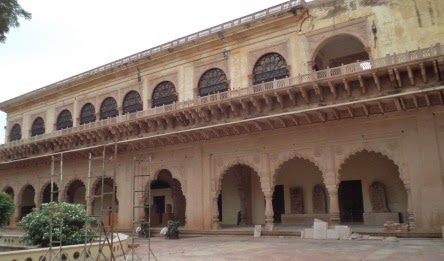 |
| Government Museum |
The
Kamra Khas was converted into a museum by Brijendra Singh in
1944 A.D that displays a plethora of antiques and decorative art of
Bharatpur from bygone times. One of
the most striking features of Kamra Khas that I had come
across is the presence of Hamam or Persian bath.
 |
| Hamam |
Hamam is derived
from Arabic and implies bathroom and formed a significant aspect of
architecture of Turkish residential palaces during 15th to
16th century. With the arrival of Turk-Mughal, a
fundamental change occurred in the bathroom architecture of medieval
India and Turkish Hamam was built in Indo-Persian style with
colourful tiles and paintings.
 |
| Hamam or Turkish bath |
The Rajputs and Jat rulers also set up
Hamam in their residences and the walls of the Hamam were spruced up
with fresco paintings, flowers and creepers on durable ariash
plaster. The Hamam at Government Museum serves as the best example of
Turkish Hamam built in Indo-Persian style during 18th
century and flaunts an interesting technology, similar to a modern
spa used by the members of the royal family to enjoy massage and heat
soaking.


